



What Payback Percentage Means in Casino Games
Payback Percentage is the theoretical share of wagers a casino game is designed to return over long-term play. It helps compare game mathematics, but it does not predict what will happen during one session, one hundred spins, or a particular PHP bankroll.
Payback Percentage in Plain Terms
Payback Percentage is commonly expressed as RTP, or Return to Player. If a game has a theoretical RTP of 96%, its mathematics are designed to return about 96% of total wagers over a very large number of rounds. The remaining 4% represents the game’s theoretical house advantage before other factors are considered.
That sounds simple until real money starts moving.
Suppose ₱10,000 is wagered through a 96% RTP game. The mathematical model corresponds to ₱9,600 returned from every ₱10,000 wagered over the long run. It does not mean depositing ₱10,000 leads to a ₱9,600 balance.
A short session might finish at ₱14,000, ₱6,000, or zero. The percentage describes the game model, not an individual result.
Turnover Is Different From Your Deposit
One detail causes more confusion than the RTP formula itself: Payback Percentage works against total wagering turnover, not simply the amount first deposited.
Imagine starting with ₱1,000. You wager ₱100, receive ₱150 back, then wager another ₱100. You have already generated ₱200 in turnover even though only ₱1,000 originally entered the account.
Repeated wins can therefore keep the same money circulating through dozens or hundreds of bets.
RTP follows the money wagered through the game, not the size of the wallet that started the session.
That distinction makes Payback Percentage far more useful and prevents the common assumption that RTP acts like cashback.
Theoretical RTP and Actual Results
Theoretical RTP belongs to the mathematics written into a game. Actual RTP is what has genuinely been paid back over a measured period.
They are related, but they should never be treated as identical.
A slot advertised with 96% theoretical RTP can return much less than 96% across a few hundred spins. Another session on the same game may run well above 100% after an early bonus round or large win.
Neither result changes the underlying theoretical percentage.
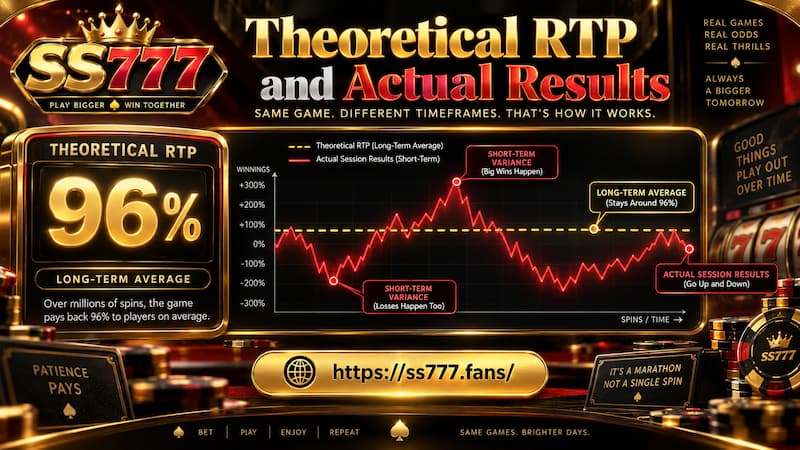
Theoretical RTP and Actual Results
Long-Term Mathematics
Payback Percentage becomes more meaningful as the sample grows. Casino mathematics rely on a very large number of wagers for actual results to move closer to theoretical expectations.
This is why reading 96% as “I should lose about 4% tonight” is inaccurate. A one-hour session is far too small to behave like the enormous statistical sample used by the game model.
Volatility Changes the Experience
Two games can both have a 96% Payback Percentage and still feel completely different.
One may deliver regular small wins that keep the balance moving gradually. Another may go through long stretches with little returned, then produce occasional large prizes.
That difference is volatility.
Higher volatility generally means results can swing more sharply. Lower-volatility play tends to distribute returns more evenly, although neither structure guarantees a particular outcome.
Payback Percentage tells you how much is theoretically returned. Volatility helps explain how that return may be distributed.
Payback Percentage and House Edge
RTP and house edge describe opposite sides of the same basic mathematical relationship.

Payback Percentage and House Edge
For a straightforward game:
- 96% RTP corresponds to a 4% theoretical house edge.
- 97% RTP corresponds to a 3% theoretical house edge.
- 94% RTP corresponds to a 6% theoretical house edge.
That makes RTP useful when comparing games with similar structures. A higher theoretical Payback Percentage generally means less mathematical advantage is built into each unit wagered.
However, not every casino game can be reduced to one percentage without context.
Rules and Decisions Can Change the Number
Blackjack is the clearest example. Its theoretical return depends partly on the exact rules and the decisions made during play. Standing on 16 against a dealer’s 10 produces different long-term mathematics from following an established basic strategy.
Baccarat also contains several wagers with different house edges, and baccarat commission can change how Banker wins are paid. Banker, Player, and Tie bets should not be treated as though they share one universal RTP.
Roulette follows the same principle. A single-zero wheel and a double-zero wheel are not mathematically identical.
So when Payback Percentage appears beside a table game, always ask one more question: Which rules and which wager does that percentage describe?
Payback Across Casino Game Types
There is no reliable universal Payback Percentage for slots, roulette, or live casino. Exact game versions matter.
Slots and Jackpot Games
A slot’s RTP comes from its mathematical configuration and paytable, not its graphics, theme, animation, or how often the reels appear to produce small wins.
Two visually similar slots can use different return settings. Even different approved configurations of the same title may not always use identical RTP values.
Progressive jackpots add another layer. Part of the game’s theoretical return may be tied to the jackpot contribution, meaning the base-game experience can differ from what a single headline percentage seems to suggest.
RTP and Hit Frequency Are Separate
A 97% slot does not automatically win more often than a 95% slot.
The 95% game could produce frequent low-value hits, while the 97% game might concentrate more of its mathematical return inside bonus rounds or less frequent large payouts.
Hit frequency answers: “How often might a winning event occur?”
Payback Percentage answers: “What portion of wagers is theoretically returned over time?”
They measure different things.
Blackjack, Baccarat and Roulette
Table games need more precision because specific choices affect expected return.
In baccarat, the mathematical cost of a Tie bet is considerably different from the main Banker or Player wagers. In blackjack, rules involving dealer behavior, doubling, splitting, and payout ratios can change the theoretical return.
Roulette depends heavily on the wheel format and bet structure.
The useful percentage is therefore the one attached to the exact game and rules being played, not a broad figure copied from the game category.
Reading Payback Percentage at SS777
When comparing games at SS777, Payback Percentage is most useful when tied to the exact title you are considering rather than used as a general label for an entire provider or category.
A sensible check takes only a minute:
- Open the game information or help section.
- Find the stated RTP or Payback Percentage when available.
- Check whether the figure applies to the exact game version.
- Read the paytable and bonus rules.
- Compare volatility, jackpot mechanics, and minimum bet size before choosing.
This creates a much sharper picture than simply selecting whichever title displays the highest percentage.
One Provider Does Not Mean One RTP
Game providers can release hundreds of titles with different mathematics. Saying that every game from one provider pays 96% is therefore unreliable unless the individual specifications support it.
The same caution applies when seeing an RTP figure quoted elsewhere. A value listed for one configuration should not automatically be assigned to another version.
Payback Percentage works best when the number can be traced to the specific game being played.
Payback Percentage in the Philippine Market
For casino content aimed at the Philippines, the distinction between theoretical and actual RTP is especially important because both concepts appear in formal gaming standards.
PAGCOR technical documentation distinguishes the theoretical return built into gaming mathematics from actual RTP measured during real operation. That separation reflects the same principle experienced in normal play: A game’s designed return and the result of a limited session are not the same thing.
This does not mean one PAGCOR percentage can be applied across every online casino title. Technical requirements depend on the game category, system, and rules being assessed.
An individual game’s own specification remains the meaningful reference.
Comparing Games With Payback Percentage
RTP becomes genuinely useful when it is treated as one part of a broader comparison rather than a score that decides everything.
Before choosing between two games, compare:
- The exact Payback Percentage.
- Volatility or prize distribution.
- Minimum and maximum wager size.
- Paytable structure.
- Bonus-round mechanics.
- Jackpot contribution, if applicable.
- Rules that affect mathematical return.
Consider two slots. Game A has 96.5% RTP with high volatility. Game B has 96% RTP with lower volatility.
The difference in theoretical return is only half a percentage point. Someone who values steadier balance movement may still prefer Game B, while another person may accept sharper swings in Game A.
Neither choice changes the mathematics. It simply recognizes that RTP alone does not describe the full experience.
Reading the Percentage Correctly
Payback Percentage is valuable because it turns an invisible piece of casino mathematics into a number that can be compared.
Its limit is equally important.
A 96% RTP does not promise ₱96 back from every ₱100. It does not predict the next spin. It does not show how often wins occur. And it does not tell you how volatile a game will feel.
Used correctly, Payback Percentage answers one precise question: How much of total wagering is this game mathematically designed to return over the long run?
Once that distinction is clear, RTP becomes a practical comparison tool instead of a misleading expectation about what the next session should produce.
- Read more: How the Draw Pile Works in Tongits