



When the Pair Plus Bet Pays in Three Card Poker
Pair Plus Bet in Three Card Poker is an optional side wager that pays when your three cards form a pair or better. The result depends only on your own hand, but the amount you receive depends heavily on the paytable used at the table you choose.
Pair Plus Bet in Three Card Poker: When It Pays
Pair Plus is simple at the point of settlement. You place the wager before the cards are dealt, receive three cards, and check whether those cards form a qualifying poker hand. There is no need to beat the dealer for Pair Plus to pay.
A winning Pair Plus hand starts at one pair. Anything below that level, such as A-K-8 with three different suits, loses the side wager.
The qualifying hands are:
- Pair
- Flush
- Straight
- Three of a Kind
- Straight Flush
One detail catches many people the first time they play Three Card Poker: A straight ranks above a flush. That feels unusual if you are used to five-card poker, where a flush beats a straight. With only three cards, however, flushes occur more often, so the ranking changes.
Winning Hand Order
From lowest to highest, Pair Plus normally follows this order:
- Pair
- Flush
- Straight
- Three of a Kind
- Straight Flush
Suppose you are dealt 7♠-7♦-Q♣. The pair is enough to trigger a Pair Plus win. If the dealer happens to hold Q♠-Q♥-5♦, the dealer may beat your main Three Card Poker hand, but that does not erase the Pair Plus result.
Mini Royal
Some Three Card Poker versions separate A-K-Q of the same suit and call it a Mini Royal. It is the strongest possible three-card straight flush.
Not every paytable treats it as a separate category. One game may pay it at a special premium while another simply settles it under the Straight Flush line. That is one reason memorizing a payout chart from another table can cause problems.
Pair Plus Payouts by Hand
Knowing that a pair wins is only half of the equation. Pair Plus payout schedules are not identical across every Three Card Poker game.
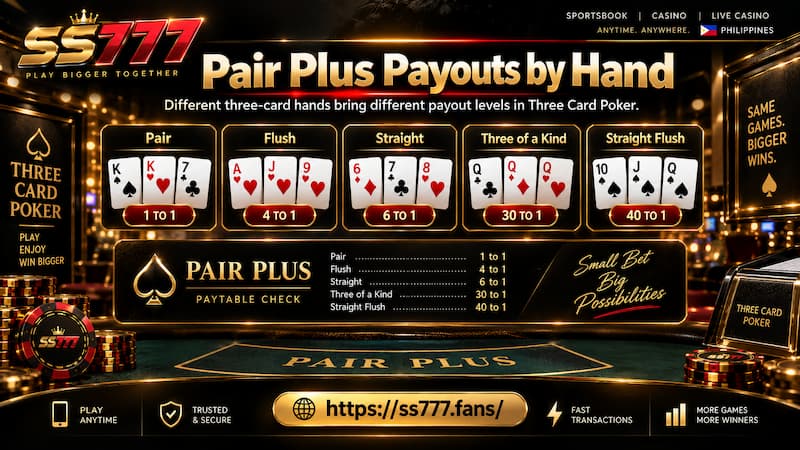
Pair Plus Payouts by Hand
A commonly seen structure may look like this:
| Hand | Example Payout |
| Pair | 1:1 |
| Flush | 3:1 or 4:1 |
| Straight | 5:1 or 6:1 |
| Three of a Kind | 25:1 to 30:1 |
| Straight Flush | 35:1 to 40:1 |
| Mini Royal | Separate payout on selected tables |
Those numbers should be treated as examples, not as a universal schedule.
A table paying 4:1 for a flush is meaningfully different from one paying only 3:1. The difference looks small on a single PHP 100 bet, but repeated over many hands it changes payback percentage and the overall return of the wager.
PHP Payout Examples
Assume a table pays 1:1 for a pair, 3:1 for a flush, 6:1 for a straight, 30:1 for Three of a Kind and 40:1 for a Straight Flush.
With PHP 100 on Pair Plus:
- Pair: PHP 100 profit
- Flush: PHP 300 profit
- Straight: PHP 600 profit
- Three of a Kind: PHP 3,000 profit
- Straight Flush: PHP 4,000 profit
A 40:1 payout usually means PHP 4,000 in winnings on a PHP 100 wager, with the original PHP 100 stake returned separately.
That distinction matters when comparing the amount shown as “win” with the final amount credited to the balance.
How Often Pair Plus Wins
Pair Plus produces attractive payouts because the stronger hands do not appear often.
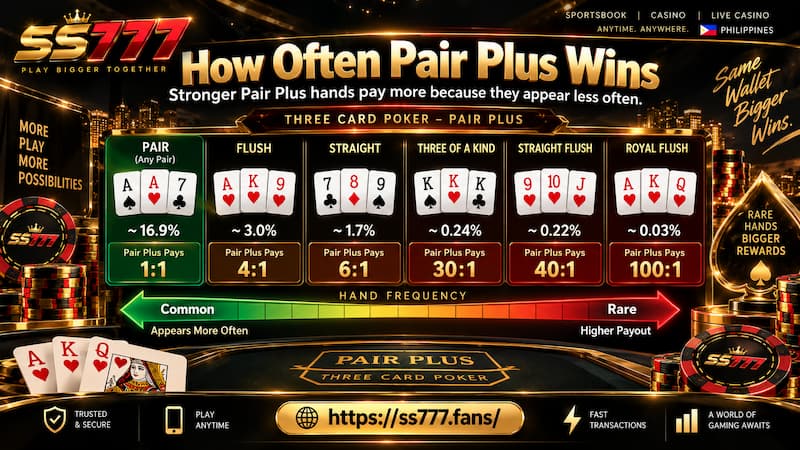
How Often Pair Plus Wins
Across the standard three-card combinations, the approximate probabilities are:
| Result | Approximate Probability |
| Pair | 16.94% |
| Flush | 4.96% |
| Straight | 3.26% |
| Three of a Kind | 0.24% |
| Straight Flush | 0.22% |
| Less than a Pair | 74.39% |
Taken together, a pair or better appears in roughly 25.6% of three-card hands. In other words, close to three out of four hands fail to qualify for a standard Pair Plus payout.
That is the trade-off built into the wager. The frequent result is a loss, while uncommon hands carry much larger multipliers.
Rare Hands and High Multipliers
Three of a Kind feels memorable because it is rare enough that you will not see it often in normal play. A Straight Flush is rarer still.
That does not mean a losing run makes one of those hands more likely on the next deal. Each fresh hand begins with a newly determined card combination. Ten losing Pair Plus bets in a row do not make the eleventh “due.”
This is also where responsible gaming matters: a losing sequence does not justify increasing the next stake simply because a win feels due.
Pair Plus rewards the hand you receive, not the history of the hands that came before it.
Keeping that distinction clear helps avoid increasing the stake simply because several previous rounds missed.
The Paytable Changes the Bet
Two Pair Plus tables can look nearly identical while producing noticeably different long-term results.
Consider these two schedules:
Paytable A
- Pair: 1:1
- Flush: 4:1
- Straight: 6:1
- Three of a Kind: 30:1
- Straight Flush: 40:1
Paytable B
- Pair: 1:1
- Flush: 3:1
- Straight: 6:1
- Three of a Kind: 30:1
- Straight Flush: 40:1
Only one number changes, but it is attached to the flush, a hand that occurs far more often than Three of a Kind or a Straight Flush. That single reduction therefore has more impact than it may appear to have at first glance.
For the commonly analyzed versions of these tables, the 1-4-6-30-40 schedule has a much lower house edge than 1-3-6-30-40.
Read the Table Before Betting
Before placing Pair Plus, check:
- The Pair payout.
- The Flush payout.
- The Straight payout.
- The Three of a Kind payout.
- The Straight Flush payout.
- Whether Mini Royal has a separate line.
The lower-paying hands deserve as much attention as the headline 30:1 or 40:1 prizes. They occur much more often and therefore have a larger influence over the practical value of the paytable.
Pair Plus and the Dealer Hand
Pair Plus is settled separately from the dealer-facing Ante and Play wagers.
Dealer qualification affects the main Three Card Poker structure, but it does not normally decide whether Pair Plus wins. Your three cards either make a qualifying Pair Plus hand or they do not.
Imagine you receive:
- Player: 8♣-8♥-3♠
- Dealer: Q♦-Q♣-5♥
Your pair of eights loses to the dealer’s pair of queens on the main hand. Pair Plus is different: The pair of eights still qualifies and is paid according to the Pair line on the active paytable.
The reverse can happen too. You might beat the dealer with a high-card hand while losing Pair Plus because your cards did not contain a pair or better.
Pair Plus Is Separate From the Ante Bonus
Pair Plus and the Ante Bonus are easy to mix up because both can reward strong three-card hands.
They are not the same bet.
Pair Plus
Pair Plus is an optional wager with its own stake. It can begin paying from a pair, depending on the rules of the game.
Ante Bonus
The Ante Bonus is connected to the Ante/Play structure and generally rewards stronger hands such as a Straight, Three of a Kind or Straight Flush.
A strong hand can therefore create more than one payment when the required wagers were placed beforehand. Each payment should be calculated independently instead of combining all stakes into one total.
Checking Pair Plus at SS777
When playing Three Card Poker through SS777, check the rules displayed for the specific game before committing PHP to Pair Plus. Different game providers can use different payout structures even when the table name looks familiar.
Confirm:
- Pair Plus is available on the selected table.
- The minimum and maximum side-bet limits.
- The exact Pair, Flush and Straight payouts.
- The Three of a Kind and Straight Flush multipliers.
- Whether Mini Royal receives a separate payout.
- Whether an Ante must be placed first.
- How PHP stakes and total returns are displayed.
A few seconds spent reading the paytable can be more useful than memorizing a generic Pair Plus chart.
Reading a Pair Plus Result Correctly
The cleanest way to settle the wager is to separate it from everything else happening on the table.
Three Steps After the Deal
- Identify your exact three-card hand.
- Match that hand with the Pair Plus paytable.
- Apply the multiplier only to the amount placed on Pair Plus.
PHP 200 Straight Example
Suppose you bet PHP 200 on Pair Plus and receive a Straight on a table paying 6:1.
PHP 200 × 6 = PHP 1,200 profit.
Your PHP 200 Pair Plus stake is also returned, bringing the total amount back from that wager to PHP 1,400.
That calculation captures the entire logic of Pair Plus Bet in Three Card Poker. A pair or better determines whether it pays, but the exact paytable determines how much the hand is actually worth.